John Cotton’s 100-Year Circular Legacy, Now Measured in Carbon
UK-based textile manufacturer partnered with KarbunWise to digitise emissions tracking, centralise ESG data, and design a Net Zero roadmap aligned with business strategy and reporting obligations.


Turning Circular Manufacturing into Measurable Climate Impact.
John Cotton Group is one of the UK's most recognised pioneers in circular manufacturing, producing bedding and mattress products through a near-closed-loop model built on recycled and waste materials. That circular foundation has defined the company for a century. What it lacked was a way to measure and prove the carbon impact of that legacy with the same rigour it applies to design and production.
Challenge
Despite a century of circular manufacturing, John Cotton had no reliable way to measure the carbon impact of its operations at scale. Emissions tracking relied on spreadsheets - manageable for Scope 1 and 2, but Scope 3 lacked supplier visibility entirely. ESG data across waste, water, and labour sat in separate departments with no shared system to pull it together.
Growing regulatory pressure from frameworks including SECR, PPN 06/21, and GRI made the status quo unsustainable. The company needed a single platform that could automate data collection, engage suppliers, and generate verified, assurance-ready insights without manual effort.
Solution
KarbunWise connected energy, transport, and procurement data to create an automated carbon workflow. There were no more spreadsheets or siloed reports. Emissions are now tracked in real time and linked directly to operational data.
The Supplier Collaboration Module enabled global suppliers to contribute verified emissions data, moving John Cotton from estimates to accuracy across its entire sourcing footprint. KarbunWise also expanded the platform to track waste, water, labour, and governance indicators - giving the team the structure to respond to sustainability assessments and third-party reviews with confidence.
Pre-configured reporting workflows let teams generate verified, standards-aligned outputs without reformatting data across frameworks. Using the Decarbonisation Pathway, KarbunWise helped John Cotton build a Net Zero strategy covering abatement levers, procurement alignment, and internal accountability - one that became part of ongoing business planning, not just a document. John Cotton also adopted the LCA Tool to calculate product-level emissions, compare design methods, and share carbon savings directly with customers.
Result
Moving from manual spreadsheets to one integrated platform changed how John Cotton operates across scope, supply chain, and long-term planning.
- Reporting effort cut by over 80 per cent Scope 1, 2, and 3 emissions now flow automatically from operational data into a single workflow, freeing the sustainability team from manual collection entirely.
- Supply chain made visible and verifiable Supplier emissions, previously estimated or unknown, are now verified and traceable across John Cotton's full global sourcing network.
- ESG reporting elevated across four indicators Waste, water, labour, and governance are now tracked systematically, strengthening readiness for external assessments and third-party reviews.
- Real-time dashboards put data in every team's hands Procurement, operations, and leadership access accurate, verified outputs instantly - no waiting on manual reports.
- Net Zero 2040 roadmap embedded into business planning Decarbonisation targets now inform procurement decisions, operational priorities, and leadership reviews across the company.
Summary
Through KarbunWise, John Cotton gained complete visibility across its global sourcing network with verified supplier inputs and strengthened ESG maturity by tracking four key non-carbon indicators: waste, water, labour, and governance.
Real-time dashboards now allow internal teams to generate verified reports instantly, while a Net Zero roadmap connects procurement, operations, and leadership decisions to measurable climate outcomes.
This transformation has turned a century of circular craftsmanship into data-backed, verifiable climate impact.
Turning Circular Manufacturing into Measurable Climate Impact.
John Cotton Group is one of the UK's most recognised pioneers in circular manufacturing, producing bedding and mattress products through a near-closed-loop model built on recycled and waste materials. That circular foundation has defined the company for a century. What it lacked was a way to measure and prove the carbon impact of that legacy with the same rigour it applies to design and production.

Challenge
John Cotton's emissions tracking relied on spreadsheets. Scope 1 and 2 were manageable, but Scope 3 lacked detail, and ESG indicators such as water, waste, and labour were fragmented across departments.

Solution
KarbunWise connected energy, transport, and procurement data into one automated workflow, added a Supplier Collaboration Module for verified emissions data, and paired it with the Decarbonisation Pathway to turn John Cotton's Net Zero ambitions into an implementable, business-wide plan.

Result
- Fully automated Scope 1 to 3 emissions tracking Significant reduction in manual reporting effort across all data collection workflows.
- Improved supplier transparency and traceability Verified supplier data replaced estimates across global sourcing operations.
- Increased ESG maturity Structured non-carbon data enhanced John Cotton's reporting quality and external assessment readiness.
Challenge
Despite a century of circular manufacturing, John Cotton had no reliable way to measure the carbon impact of its operations at scale. Emissions tracking relied on spreadsheets - manageable for Scope 1 and 2, but Scope 3 lacked supplier visibility entirely. ESG data across waste, water, and labour sat in separate departments with no shared system to pull it together.
Growing regulatory pressure from frameworks including SECR, PPN 06/21, and GRI made the status quo unsustainable. The company needed a single platform that could automate data collection, engage suppliers, and generate verified, assurance-ready insights without manual effort.
Solution
KarbunWise connected energy, transport, and procurement data to create an automated carbon workflow. There were no more spreadsheets or siloed reports. Emissions are now tracked in real time and linked directly to operational data.
The Supplier Collaboration Module enabled global suppliers to contribute verified emissions data, moving John Cotton from estimates to accuracy across its entire sourcing footprint. KarbunWise also expanded the platform to track waste, water, labour, and governance indicators - giving the team the structure to respond to sustainability assessments and third-party reviews with confidence.
Pre-configured reporting workflows let teams generate verified, standards-aligned outputs without reformatting data across frameworks. Using the Decarbonisation Pathway, KarbunWise helped John Cotton build a Net Zero strategy covering abatement levers, procurement alignment, and internal accountability - one that became part of ongoing business planning, not just a document. John Cotton also adopted the LCA Tool to calculate product-level emissions, compare design methods, and share carbon savings directly with customers.
Result
Moving from manual spreadsheets to one integrated platform changed how John Cotton operates across scope, supply chain, and long-term planning.
- Reporting effort cut by over 80 per cent Scope 1, 2, and 3 emissions now flow automatically from operational data into a single workflow, freeing the sustainability team from manual collection entirely.
- Supply chain made visible and verifiable Supplier emissions, previously estimated or unknown, are now verified and traceable across John Cotton's full global sourcing network.
- ESG reporting elevated across four indicators Waste, water, labour, and governance are now tracked systematically, strengthening readiness for external assessments and third-party reviews.
- Real-time dashboards put data in every team's hands Procurement, operations, and leadership access accurate, verified outputs instantly - no waiting on manual reports.
- Net Zero 2040 roadmap embedded into business planning Decarbonisation targets now inform procurement decisions, operational priorities, and leadership reviews across the company.
Summary
Through KarbunWise, John Cotton gained complete visibility across its global sourcing network with verified supplier inputs and strengthened ESG maturity by tracking four key non-carbon indicators: waste, water, labour, and governance.
Real-time dashboards now allow internal teams to generate verified reports instantly, while a Net Zero roadmap connects procurement, operations, and leadership decisions to measurable climate outcomes.
This transformation has turned a century of circular craftsmanship into data-backed, verifiable climate impact.
.jpg)
Sustainability Manager, John Cotton Group
Related Articles

The EU Just Cut CSRD Reporting Requirements by 60%. Here Is What Actually Changed.
The EU has significantly changed CSRD reporting requirements. Explore the revised ESRS, what changed, who remains in scope, and what businesses need to do next.
Read more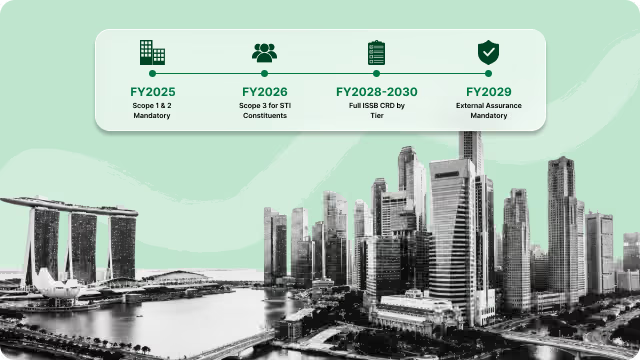
ACRA's 3-Tier Climate Reporting Rules: Deadlines, Disclosures, and What to Do Now
Singapore's climate reporting requirements are already here. Understand the 3-tier structure, SFRS S2 disclosures, reporting deadlines, and how to prepare for the FY2029 assurance requirement.
Read more
Australia's Mandatory Climate Reporting (2026): AASB S2 Deadlines, Groups & Readiness Checklist
Everything Australian organisations need to know about AASB S2 climate reporting, reporting groups, deadlines and compliance readiness.
Read more%20(2).avif)
Top 5 LCA Software Tools in 2026
Explore the top LCA software tools of 2026 and compare their features, strengths, and use cases for lifecycle assessment, carbon footprinting, and sustainability reporting.
Read more
SBTi FLAG Guidance v1.2: What Changed and What to Do Next
Learn what's new in SBTi FLAG Guidance v1.2, including updated deadlines, mandatory commodities, no-deforestation requirements, and practical steps for businesses.
Read more
Primary vs Secondary Emissions Data: Key Differences and When to Use Each
Learn the key differences between primary and secondary emissions data, when to use each, and how better data quality supports more accurate carbon accounting and Scope 3 reporting.
Read more
How to conduct a double materiality assessment: A practical step-by-step guide (2026)
Learn how to conduct a Double Materiality Assessment with this practical step-by-step guide covering impact and financial materiality, IROs, stakeholder engagement, scoring, materiality matrices, and ESG reporting.
Read more
How to Get a Job in Sustainability in 2026: Careers, Salaries, Skills & Certifications
A complete guide to sustainability careers in 2026, covering career paths, salaries, essential skills, certifications, and leading learning programmes for aspiring sustainability professionals.
Read more

.avif)








.png)
.svg)