Oman Climate Week 2026
KarbunWise at Oman Climate Week in Muscat, where Article 6, carbon markets and CBAM were on the agenda.
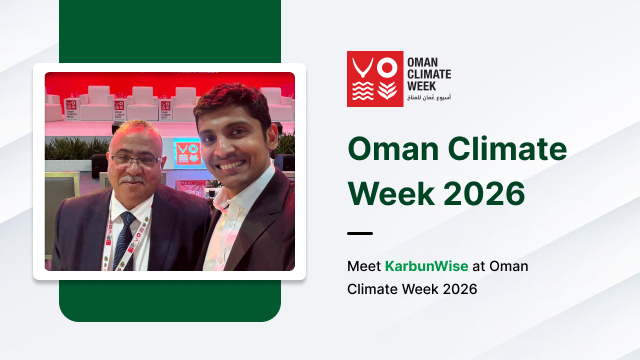
The second edition of Oman Climate Week took place at the Oman Convention and Exhibition Centre in Muscat. It was organised by Oman’s Environment Authority under the patronage of Sheikh Al-Fadl bin Mohammed Al-Harthi, Secretary-General of the Council of Ministers. More than 50 countries took part.
The theme was moving from climate ambition to implementation. Over three days, the programme included a climate solutions exhibition, a CEO panel, a dedicated Article 6 implementation event, B2B matchmaking, and conferences on renewable energy and waste management.
Who should participate
- Sustainability and climate teams at industrial companies
- Exporters preparing for CBAM
- Carbon market developers, buyers and registries
- National authorities working on Article 6
- Verifiers, consultants and EPD practitioners
Why We Attended
KarbunWise attended Oman Climate Week to meet organisations across the Middle East working on carbon markets, CBAM and product sustainability.
- Hear how Gulf countries are putting their Article 6 frameworks into practice
- Talk with industrial companies about how they measure and verify emissions
- Understand where CBAM and regional carbon markets overlap for exporters
- Meet practitioners and policymakers from across the region
Post-Event Synopsis

Arjun Vijayaragavan
Founder & CEO
KarbunWise
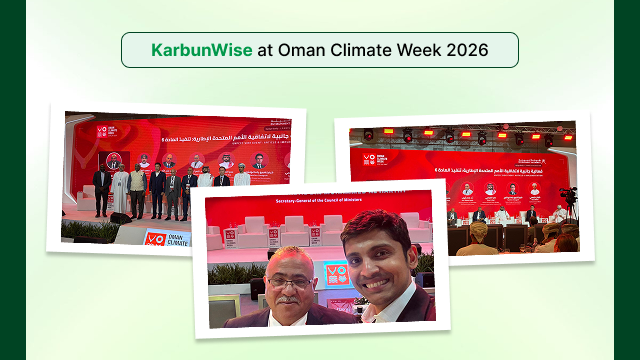
The first day opened with keynotes and high-level discussions. Oman shared updates on its carbon neutrality strategy and its national carbon market framework.
The second day focused on climate finance and Article 6 of the Paris Agreement. Speakers from the Oman Net-Zero Centre outlined how the country’s carbon registry and project pipeline are developing.
The third day turned to climate resilience and nature-based solutions, and closed with the final pitches of the Ecothon climate innovation challenge.
For us, the most useful session was the panel “Making Article 6 Transactions Happen in the Middle East”. Dr. Nasser Ayoub spoke on it, representing EPD International. The region has built its Article 6 frameworks, and the panel looked at what is still needed to close real transactions. Five points came out of the discussion:
- Selling credits abroad is a planning decision - Every unit sold abroad is subtracted from the country’s own target, so countries should keep the cheapest reductions at home.
- Both Article 6 routes are useful - Bilateral deals under Article 6.2 suit early transactions, while the Article 6.4 mechanism is built for scale.
- The paperwork has to come first - An initial report, a registry and a written authorisation procedure need to be in place before the first transfer.
- Regional demand matters - Saudi Arabia’s GCOM, the UAE’s National Carbon Credit Registry and CORSIA for Gulf airlines can all create buyers.
- Data is the biggest barrier - Many factories keep production records for accounting, not emissions. A project can pass every policy step and still fail at verification.
The panel closed on a point we see in our own work: if a plant measures its emissions properly once, the same data can support carbon credits under Article 6, CBAM declarations and verified EPDs.
Visit us?
KarbunWise attended Oman Climate Week at the Oman Convention and Exhibition Centre in Muscat to discuss Article 6, carbon markets and CBAM with teams across the Middle East.